



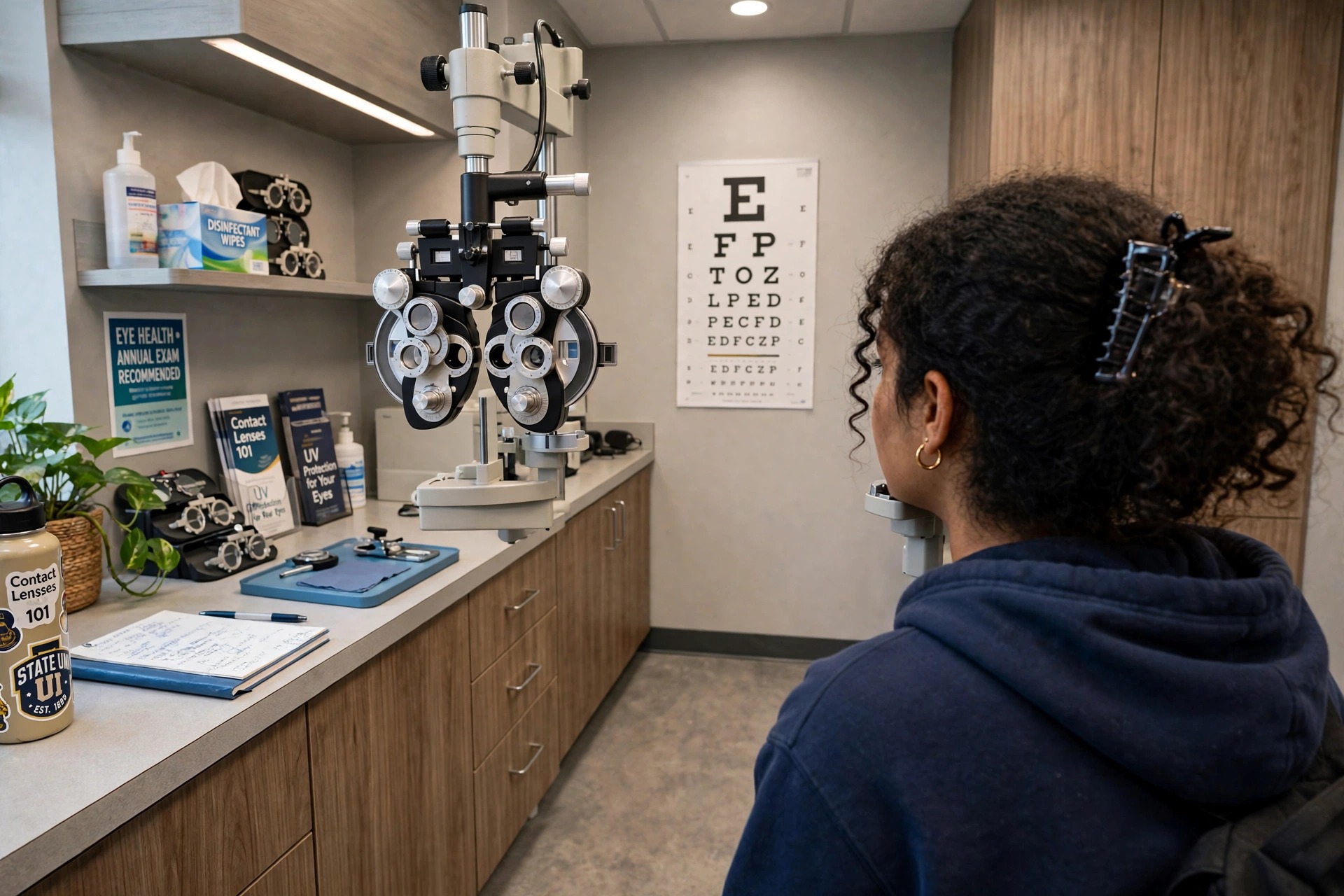
Harry S Truman High School will host FREE vision screenings for students from Wednesday, December 16 through Friday, December 18, 2026.
Students will be escorted to their screening by their PE/Health teacher during the regular school day — no appointments, no cost, and no trip to an outside office required.
Why vision screening matters
Vision is the foundation of classroom learning, yet vision problems are among the most common — and most overlooked — health issues facing school-aged children:
- One in four school-aged children has a vision problem that can affect learning, according to the American Optometric Association.
- Up to 80 percent of what children learn in school is presented visually, according to the National Eye Institute / Discovery Eye Foundation estimates.
- The National Commission on Vision & Health found that 79 percent of children had not visited an eye care provider in the past year, and 35 percent had never seen an eye care professional at all.
- Nationally, more than 600,000 children have uncorrectable visual acuity loss, including over 45,500 who are blind, according to Prevent Blindness data drawn from the CDC’s Vision and Eye Health Surveillance System. That is roughly 1 out of every 122 children in the United States.
- Undetected and untreated eye disorders, such as amblyopia (“lazy eye”) and strabismus, can delay reading and cause a student’s performance in school to suffer.
- Researchers estimate that as many as 60 percent of children identified as having learning difficulties may have an underlying, undetected vision problem.
The challenge is that children rarely complain. A student who has always seen the world blurry assumes everyone sees it that way. The warning signs — squinting at the board, losing their place while reading, avoiding homework, headaches, or falling concentration — are easily mistaken for disinterest, attention problems, or a learning disability, when the real issue may simply be that the student cannot see clearly.
Early detection changes the trajectory. A quick, painless screening at school can identify students who need a full eye exam and glasses — and remove a hidden barrier to reading, grades, confidence, and participation in class.
What parents need to do
A consent form is being mailed home to all families.
You only need to act if you do NOT want your child screened. In that case, return the completed form to Room 230.
If the form is not returned, your child will take part in this free screening during the school day, December 16–18.
Questions?
Contact the school’s main office or stop by Room 230.
At Truman, we want every Mustang to see the board, see the page — and see a bright future ahead of them.